 |
 |

|
Kurt Moses Vice
President, Academy for Educational Development
Administration of a school system has always been challenging. In many centralized systems, simply supporting all the activities of schools remains critical and challenging, particularly in recruiting, hiring, placing, and supporting teachers, but as well all the necessary logistical support in terms of buildings, furniture, maintenance, instructional materials, training of staff, and all the quality control activities surrounding good education. The ever increasing shift to decentralization, coupled with the escalating demands for logistical support as more schools become more sophisticated, have placed major burdens on Information Systems and the information they produce that policy, managerial, and operational leaders require to administer systems properly. Whether education occurs in a developing country with less than $150 per year to spend per pupil or a more developed environment with $2,500 per year to spend per pupil, many of the same, fundamental administrative issues persist. Major Informational Issues In recent years, whether systems are centralized or decentralized, democracy has encouraged more stakeholders to ask more questions about education. Some examples include:
In many developing countries, the entire education information system structure is inadequate for the rapidly growing information demands. Obtaining quality education data is often elusive, costly and frustrating. In many cases, available data may be:
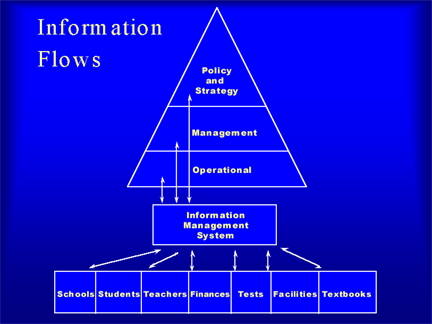
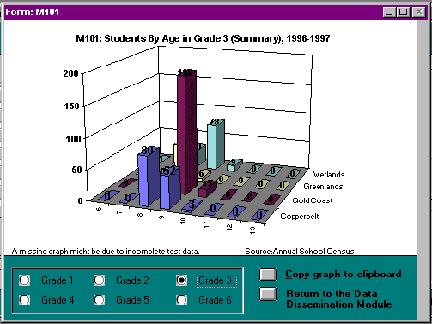
These identified issues and particularly the one-directional flow of information are deeply at odds with both democracy and decentralization–the rising trends at almost all levels of educational administration. Education Information System: What It Takes Vision: The leadership of the most responsible educational body must be clear about the functions and scale of their information needs. This vision can be informed by international and regional practices–but it must be grounded in local and national reality. People: The people who will implement and support an information system must have “ownership,” understand the role that information plays in the educational life of the country, and be competent in its use (meaning the necessary skills base). Practices: Many existing practices may need to be reengineered to accommodate changes in how and how frequently information is gathered, as well as to make use of improved technology. Practices also include setting basic standards: timing of information, responsibility for information, common definitions, frequency of distribution, and clarity of presentation. Technology: Technology should be appropriate to the functions and scale of the system, and be sustainable. The very latest technology, if unsupportable for more than one year, soon becomes useless and can actually set a system back. Technology requires redundancy (more than one of everything), regular maintenance, supplies to keep it working, alternative approaches when it fails, and people trained to diagnose and support its operation. Someone Responsible: An Information System requires that someone be responsible to keep it operating. So often in traditional ministries or even Districts, there is no such position as an Information Officer responsible for system integration and service. Without such a person and staff, most Information Systems have a tenuous life. Most ministries that anticipate this need (often as part of the Planning Unit) rename an existing civil service position. Increasingly, an experienced manager, not a technician, should hold this position. A manager then hires or subcontracts for the necessary technical advice. Three Levels of Information The design of an information system (even if it incorporates old systems or manual procedures) should accommodate at least three levels of information as noted in Exhibit 1, below. These levels, in a centralized system, often correspond to the actual administrative levels–i.e., National, District, and School. In decentralized systems, policy and strategy level information can be vested at the District level or with citizen groups. Critical for proper integration is that all core data originate from the school in some fashion. The school is the heart of an effective education information system. The three levels of information that need to be supported are: Policy and Strategy Level: Policy and strategy typically involve comparison of multiple years, from sources both outside and inside the educational system, and often involve macro analysis–for example, how many children of school age are enrolled in school? Management Level: Management questions relate to the typical inputs of a school system - students, teachers, facilities, and instructional material - and relate to performance by groups. Management level information typically is week to week or month to month, and involves aggregates of students, teachers and instructional material–for example, how many teachers were on the payroll last month? Operational Level: Operation level information concerns the actual, individual operation of the system and includes detailed student and teacher count. The most critical operational element of any school system is the teacher support system. In many developing countries and a number of transitional countries, salaries and benefits consume 80-90% of the available budget. In most countries, the teacher payroll is the largest single payroll in the country. Therefore, it stands to reason that staffing and payroll information is crucial to effective management. In many countries, staffing levels are driven by numbers and types of students, and thus any effective education information system must be as exact as possible about numbers, level, and location of students. The same applies to teachers. To achieve this exactness, all information must be generated either directly from the school or from a central payroll file–in some cases from both. While these information distinctions are not exact, they allow education information system designers to provide an appropriate amount of detail for the appropriate level of responsibility and question. Unfortunately, however, many existing systems are not designed this way. An Example of an Integrated, Multilevel Approach There is presently a system called ED*ASSIST that reflects the above framework, in terms of its inputs and processing components. It can be seen on the website: www.aed.org/edassist. The product of collaborative efforts over a five-year period involving UNESCO, the World Bank, USAID, and several countries, its use in four countries, with English, Spanish, and French versions is also described and illustrated. Below are some illustrative elements of the system. Exhibit 2 illustrates an opening computer screen that gives access to the three levels of information, by geographic type (national, regional, district, sub-district, and school), by level of education (preprimary through tertiary), by year (1997, 1996, 1995) and by special category of school (public, private, other). This screen allows the users, from their computer, to view information graphically, statistically (as a table) or in a Geographic Information System format– i.e., a map. Alternatively, such information can be printed out, incorporated into a report (another document), or linked to a website. All the information is derived from an updated database that either accesses other operational systems, or is derived from survey results or other queries to schools. Exhibit 3 shows a Graphical Student Display–ages of students in particular grades by region. Such a presentation provides, at the managerial level, a quick “snapshot” of the number of over-age students in each classroom. Because it presents multiple regions, or districts, a manager or policy maker can quickly see patterns and comparisons. Similarly, such presentations can be used with citizen groups to highlight the need for action around student enrollment issues. Exhibit 4 provides very geographically oriented information, in this case Gross Enrollment Rates by region within a country. The colors show ranges of enrollment and quickly highlight disparities between regions. From such a presentation, the manager, policy maker, or citizen group (usually with some trained assistance) can then begin to make some factual inquiries–looking at patterns below the regional level, beginning to understand the causes of under-enrollment. Exhibit 5 shows one of the most common measures of school resources -- the student/teacher ratio -- in a graphical format. Such quick comparisons show where teaching resources (typically the most important single factor in school systems) are going compared to enrollments. Comparisons at lower levels and comparisons with test performance or levels of dropouts from the system are immediate types of inquiries that such a report generates. Again, this type of graphical summary, in a modern education information system, can be accessed from the computer, via report, as a printout, over the Web, or made into a flip chart. Exhibit 6 provides operational level detail on teachers at each school. As noted, this screen provides individual, detailed information about the staffing complement of a particular school along with key profile items for the teacher. Developed from school level data, these individual profiles can answer very quickly specific queries that can be found at almost any level of the system. For some more developed countries, such individual information will require masking for privacy reasons, but for the majority of countries such information is substantially more than they can generate now. Some Future Options In the not very distant future, education information systems will become more comprehensive, faster to respond, and considerably cheaper than they are now. Even countries with remote areas will find that the use of satellite and other techniques will become cheap enough to link individual schools directly to administrative hubs. Similarly, the dramatically falling price of equipment will allow even the smallest unit (the school) to afford automated systems. Several other trends are clear: Information about school performance will be increasingly demanded by the populations served, by freely elected governments, and by administrators at all levels. Information systems will need to be able to respond or the government or private entities will be seen to be unresponsive. Already, in a few countries, there are now no technical barriers to accessing key information about any school in the system–simply administrative and policy barriers that limit the flow of information. Increasingly information will be asked about classroom activities and how individual teachers and students perform. This will require a new level of detail in information and an increasing focus on the quality of education measured in a variety of ways, and many of these measures will be externally established and monitored. Decentralized systems will need to establish standards as never before, monitor their implementation and insist upon their use, particularly as long as substantial monies come from the center and are then allocated. Standards will also be needed to ensure that the national ministry or organization can be an effective, well-informed advocate for national educational needs and goals. The World Wide Web will become the key tool, both internally and externally, for the generation, exchange, and even processing of administrative information. Virtually all-existing systems, even in emerging countries, will need to be converted to operate on the Web. Administrative
use of the World Wide Web will also be aided by increasing use
of the Internet for support of instructional material and aides to learning
improvement. This offers remarkable opportunities for synergy between
learning and monitoring on a massive, efficient and affordable scale.

|
|||||||
|
For feedback on this article, please write to: TechKnowLogia@KnowledgeEnterprise.org |
|||||||
|
Subscribe | Reader Feedback | To Sponsor | To Advertise Editorial Network | Editorial Policy | Home |
|||||||
|
|
|||||||
| TechKnowLogia, May/June 2000 | Copyright © 2000 Knowledge Enterprise, Inc. | ||||||