|
The
Role of the Instructor in
Lucio
Teles, Stacy Ashton, Tracy Roberts, Irina Tzoneva
In the past decade the implementation of e-learning in education and the corporate sector has led to a proliferation of technologies aimed at supporting virtual learning. From email to real-time chat rooms to asynchronous conferencing software, the Web has played a large role in the computerization of the classroom, especially in post-secondary institutions. Much of the early research into this trend focused on describing the new technology, and on hailing the potential of these advances to foster learning environments where students can collaborate with one another and take on increased responsibility for their own learning (Feenberg, 1989; Harasim, Hiltz, Teles & Turoff, 1995; Hiltz, 1994; Kerr, 1986; Mason & Kaye, 1989; Moore & Kearsley, 1995). Although much of the rhetoric around online classrooms focuses on collaboration, it is important to point out that online classrooms are not necessarily collaborative in nature. McCabe (1998), Berge (1996) and Eastmond (1995) all offer cases of online classrooms modeled on traditional, non-collaborative educational models. In order to investigate the role of instructors who are using collaborative online environments as part of their teaching we have chosen to study courses in which student participation in collaborative online discussions and projects was a significant component of the student’s experience and assessment in the course. The courses selected for the research were also delivered entirely online. In this study we provide an in-depth investigation of the kinds of activities. It begins with a review of the literature describing the key characteristics of collaborative online environments, and the implications of these characteristics for the role of the online instructor. Characteristics of Collaborative Online Environments A variety of characteristics have been identified in the literature concerning collaborative online classrooms. Harasim et al. (1995) and Warschauer (1997) argue that online classrooms hold great potential for collaborative educational approaches because they feature many-to-many communication, place and time independence, and computer-mediated communication (CMC). These characteristics point to several critical focus areas in the investigation of the role of the instructor in the online environment: changes in the balance of student-instructor participation; a move towards active collaborative learning; changes in the teaching role towards increasing facilitation versus direct instruction. Instructor Roles in E-Learning Environments In the present research, Berge’s instructors roles - pedagogical, managerial, social, and technical - have been used as a starting point to analyze instructor postings in online settings, and to help organize the literature on the role of the online teacher (Berge 1995, 1996). Pedagogical: The pedagogical role encompasses everything done to support the learning process of individual students or working groups. Based on the application of Vygotsky’s sociocultural theory to an online course for pre-service teachers, Bonk, Daytner, Daytner, Dennen, and Malikowski (1999) provide a breakdown of ways instructors can use instruction and facilitation during online discussions. The following role behaviors fall clearly into the dimension of pedagogical functions: direct instruction; direct questioning; providing modeling or examples; giving advice or suggestions; fostering student reflection or self-awareness; pushing students to explore other sources of information; prompting students to explain or elaborate on their ideas; providing feedback or praise; cognitive task structuring; 'weaving' students’ contributions into a single summary in order to capture and re-focus students on the essence of ongoing or completed discussions (Harasim et al., 1995). Managerial: The managerial role refers to activities designed to make the course run smoothly at an administrative level. Management roles fall into three categories: managing individual students; managing discussion and working groups; managing course functions. Social: The lack of nonverbal signals and social context cues means that in online classrooms, an education-ready atmosphere is built entirely from virtual tools and interactions. Walther (1996) developed a three-level model of the social effects of computer-mediated communication (CMC) focusing on impersonal, interpersonal and hyperpersonal effects. Technical: The technical role involves choosing appropriate software to meet specific learning goals, and assisting students to become competent and comfortable users of the chosen software. Research Questions and Methodology The present research study was designed to explore the application of Berge’s (1995, 1996) four role dimensions to actual online collaborative classroom environments. We were interested in the specific behaviors that occurred in each of the four role dimensions, as well as the distribution of the roles across members of the online classroom and over time. The specific questions posed in this research are:
The primary methodology chosen for this study was transcript analysis of instructor postings to online conferences in classes where a significant portion of class time and grade was rooted in collaborative activity. Analysis of postings was limited to the instructors, tutor markers, and technical support staff. Because we did not have permission to view student postings, these postings were not included as part of our body of data, and all references to students that came up in the analyzed postings were replaced with numbers before analysis began. Consensual Qualitative Research Since a large part of our analysis involved developing a framework of instructional behaviors in each of Berge’s four role areas, we adopted a modified version of the Consensual Qualitative Research (CQR) methodology (Hill, Thompson, Williams, 1997). The CQR process involved developing categories for broad domains derived from a review of the literature in order to provide a loose conceptual framework or "start list" that allowed us to cluster data relevant to the research issue into topic areas. Our start list was developed to ensure that we attended to support functions in the online classroom, as well as to direct teaching. Based on a framework developed by Berge (1995), two researchers independently coded instructor postings from one of the Dancing courses into the four general instructional roles: Pedagogical, Managerial, Social, and Technical. We used NUDIST4 (Non-numerical Unstructured Data by Indexing, Searching and Theorizing, Version 4), a qualitative research software program, to assist us in organizing the transcript data into subcategories, so that we can develop a taxonomy of the specific instructional actions within each of the four instructional roles. In order to get feedback on our framework of instructional roles and behaviors, we organized an online conference to present preliminary findings to a group of experienced online instructors. Fifty-three participants joined the discussion. Of these, 41 were "readers" only and did not contribute to the discussion and 12 were active participants and generated 141 messages in a highly interactive online seminar. The two research assistants working in data analysis independently developed a coding scheme that categorized the abstracted postings into a set of the core instructional actions within each instructional role. The final framework of instructional behavior, presented below, was developed through a reflexive and reiterative process of coming to consensus on how the posting abstracts best fit together into core ideas that represented the data. Inter-rater reliability between the two coders ranged from 66.5% to 96.2%, depending on the course. Since over 950 postings were coded, a significant proportion of the inter-rater variance was thought to be rooted in simple coding fatigue. As the coders were re-visiting the data, the dominant reason for a disagreement was that one or the other of the coders had overlooked a clear example of one of the roles in action. Only 10% of the codes that were disagreed upon sparked serious discussion in our consensus meetings. All coding was discussed to consensus. Courses Selected for Data Collection We chose to study multiple offerings of three courses, so that we could track changes in role distribution as the instructor gained more experience with their online classroom. Many of the case studies reported in the literature are based on first-time online instructors piloting a new course (e.g., Garland, Wang & Teles, 1999; Latting, 1994; Slatin, 1992). We wanted to examine the changes that occur as instructors become more comfortable with the technology and course content. The three courses were selected to represent a diverse range of topic areas and level of student: a virtual dance course for undergraduate students, a first-year undergraduate statistics course, and a graduate course in psychiatric nursing. Course 1: Dancing in Cyberspace (referred to as FPA – Faculty of Performing Arts) In this course, students were introduced to the virtual body and its vast creative potential in cyberspace. Students learned Life Forms, a software for 3-D human figure animation, to analyze and create simulations of human dance sequences. Two offerings of this course were analyzed. In the first offering, there were 28 students and in the second there were 19. Collaboration and online discussion among students were major features of both offerings of this course. Students carried out weekly topic discussions based on the course readings in an online "Topics" conference, which were summarized and posted by the tutor marker at the end of each topic. Life Forms animation issues were discussed in an "Animation" conference. A busy "Café" conference provided a virtual place for casual, social chat. In addition, students worked in assigned pairs to create, perform and critique animated dance sequences, which also promoted high levels of online interaction. Seventy percent of the course grade required some form of online discussion or peer collaboration. Course 2: Introduction to Statistics (referred to as STAT) Statistics was a first year undergraduate course designed to introduce students to statistical tools and concepts used to collect and analyze data. Three offerings of this course were analyzed, all of which were taught by the same instructor and tutor marker. The first offering of the course enrolled 64 students, the second, 30 students, and the third, 24 students. Collaboration consisted of topic discussions in small groups of four to five students, as well as group assignments that were submitted to the tutor marker every two weeks. The students themselves, on a rotating basis moderated group discussion. Group submissions and participation made up 25% of the students' final grade. Course 3: Community Concepts for Psychiatric Nursing (Nursing also referred to as PNUR) This course was offered to students enrolled in an advanced diploma program in psychiatric nursing. Students analyzed the context of psychiatric nursing in the community from a systems theory perspective. Collaboration was built into the course in the ongoing discussions about course topics, and through peer feedback on the major project required for the course. Two offerings of this course were analyzed, both of which were taught by the same instructor, who worked without a teaching assistant. There were five students enrolled in the first course, and nine in the second. Most of the students in this course were already working as psychiatric nurses, and thus brought a great deal of experience to the course. Results and Discussion The results from our research show the distribution of the subcategories of the online instructor’s roles, the student-instructor participation rate, and the relative proportion of instructional roles. 1. Subcategories of the four roles of the online instructor The following subcategories were identified for each of the four roles of the online instructor:
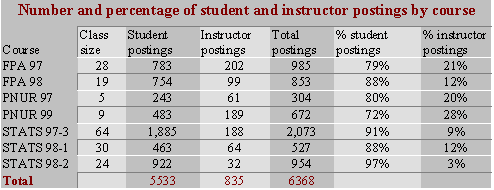
The relative student-instructor participation rate followed the same trend identified by earlier researchers: instructor postings accounted for as little as 3% of postings to conferences in one of the Statistics courses, to as high as 28% in the smaller graduate Nursing course. These correlations show that although the number of student postings rises as the number of students in the course rises, the number of instructor postings does not.
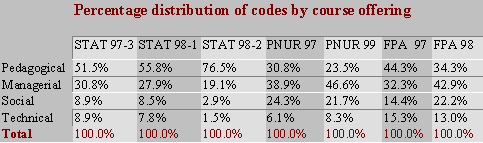
3. Relative proportion of instructional roles Several trends emerged in our analysis of the distribution of roles by course offering. In all courses, instructor postings contained more Pedagogical and Managerial codes than Social and Technical codes. This was most striking in the three Statistics offerings, in which 82%, 83% and 96% of the instructional behavior was pedagogical or managerial in nature.
In many cases, the pattern of pedagogical and managerial codes being dominant over social and technical codes occurred equally at all stages of the course. In addition, more managerial codes appeared at the early stages of courses that had been offered more than once, usually accompanied by a shift of pedagogical activity into the middle and late stages of the course. This suggests that more managerial issues were anticipated and dealt with earlier in the course as instructors gained online experience. Conclusions, Limitations, And Future Directions Exploring instructor roles and instructional activities in this way gave us a window into the amount of time instructors spend fulfilling various roles and activities. One finding is that instructors spend the bulk of their managerial time coordinating the receipt of assignments. Concerns about viruses and incompatible software can make the apparently simple action of handing in an assignment quite complex in an online classroom. Analysis of these courses has also shed light on how instructors distribute role functions between themselves and instructor adjuncts such as tutor markers or teaching assistants. Cross-analysis of the seven courses showed some commonalties in the ways instructors organize their classrooms. Several limitations of this research will require additional work in this area. First of all, transcript analysis does not capture the entirety of the online classroom. Several of the instructors studied in this research stated that a significant amount of student-instructor contact occurred outside the online conference, either through face-to-face office hours or private e-mail. Thus, only a partial picture of the role breakdown and activities of instructors is possible through transcript analysis that focuses on the content of class conferences. In addition, a great deal of preparation and organizational maintenance occurs in an online course which is also not captured in the online conferences: developing lesson plans and assignments, marking, meeting with teaching assistants, and other activities. In order to examine the activities of the online instructor as a total package, data would need to be collected on these other aspects of online instruction as well. REFERENCES Berge, Z.L. (1996). Example case studies in post-secondary, online teaching. In G. Hart & J. Mason (Eds.), Proceedings of ‘The Virtual University’ symposium (pp. 99–105). Melbourne, Australia, November 21–22. Berge, Z.L. (1995). Facilitating computer conferencing: Recommendations from the field. Educational Technology, 35, 22–30. Bonk, C.J., Daytner, K., Daytner, G., Dennen, V., & Malikowski, S. (1999). Online mentoring of preservice teachers with web-based cases, conversations, and collaboration: Two years in review. Paper presented at the American Educational Research Association annual meeting, Montreal, Canada, April. Eastmond, D.V. (1995). Alone but together: Adult distance conferencing through computer conferencing. Cresskill, NJ: Hampton. Feenberg, A. (1989). The written world: On the theory and practice of computer conferencing. In R. Mason and A. Kaye (Eds.). Mindweave: Communication, computers, and distance education (pp. 22-39). Oxford: Pergamon Press Garland, I., Wang, X., & Teles, L. (1999) Fostering creativity through cross-disciplinary collaboration in an online dance course. Paper presented at the Computer Supported Collaborative Learning Conference, Stanford University, Palo Alto, CA, December. Harasim, L., Hiltz, S.R., Teles, L., & Turoff, M. (1995). Learning networks. Cambridge, MA: MIT Press. Hill, C.E., Thompson, B.J., Williams, E.N. (1997). A guide to conducting consensual qualitative research. The Counselling Psychologist, 25(4), 517–572. Hiltz, S.R. (1994). The virtual classroom: Learning without limits via computer networks. Norwood, NJ: Ablex Publishing Corp. Kerr, E.B. (1986). Electronic leadership: A guide to moderating on-line conferences. IEEE Transactions on Professional Communication, 29, 12–18. Latting, J.K. (1994). Diffusion of computer-mediated communication in a graduate social work class: Lessons from "the class from hell." Computers in Human Services, 10(3), 21–45. Mason, R. & Kaye, A. (1989). Mindweave: communication, computers, and distance education. Oxford: Pergamon Press. McCabe, M.F. (1998). Lessons from the field: Computer conferencing in higher education. Journal of Information Technology for Teacher Education. 7(1), 71–87. Moore, M.G. & Kearsley, G. (1995). Distance education: A systems view. Belmont, Wadsworth Publishing. Slatin, J.M. (1992). Is there a class in this text? Creating knowledge in the electronic classroom. In E. Barrett (Ed.) Sociomedia: Multimedia, hypermedia, and the social construction of knowledge (pp. 27–52). Cambridge, MA: MIT Press. Walther, J.B. (1996). Computer-mediated communication: Impersonal, interpersonal, and hyperpersonal interaction. Communication Research, 23(1), 3–43. Warschauer, M. (1997). Computer-mediated
collaborative learning: Theory and practice. The Modern Language Journal,
81(4), 470–481.
|
||
|
For feedback on this article, please write to: TechKnowLogia@KnowledgeEnterprise.org |
||
|
Subscribe | Reader Feedback | To Sponsor | To Advertise Editorial Network | Editorial Policy | Home |
||
|
|
||
| TechKnowLogia, May/June 2001 | Copyright © 2001 Knowledge Enterprise, Inc. | |