
|

Ghana: Networking for Local Development How you can use a computer without owning one By Mary Fontaine and Dennis Foote The LearnLink Project, Academy for Educational Development (AED )
One of the fundamental dilemmas that have emerged alongside the development of new information and communication technologies is how to insure equitable access to the benefits of those technologies. In most developing countries, it is not reasonable, for a long time to come, to expect that the industrial world’s model of private ownership of computers will prevail. In the meantime, it behooves us all to help ensure that even poor people have access to computers and to the benefits that come from their use. We cannot afford to live in a world in which the dominant technology widens the gap between rich and poor. The problem before us is to find a way for people who do not own their own computer to participate fully in modern societies and economies. The TELECENTER Concept One model for providing public access that is growing rapidly around the world is the telecenter. The idea has a close parallel to the early days of telephones. In those days, only the elite had their own telephones, so society evolved the concept of public telephones, which anyone could use, paying only the cost of their actual use. Similarly, telecenters are public places where people can come to use computers when they need them.In practice, the telecenter model is very diverse. Some charge for services, but some are free. Some are connected to the Internet and some are stand-alone. Some are commercial and some are not-for-profit. Some exist primarily to serve businesses and some to serve the rank-and-file population. Some specialize in training in software applications and helping new users, while others focus on serving experienced users who want to come in and do email, participate in online distance education, or play computer games. Some are in bus stops, others are in pizza parlors or libraries or shopping malls. Some are large with many machines and employees, while the smallest ones consist of a single unstaffed computer kiosk. The Activity in Ghana One interesting project in Ghana is exploring the practicality of non-governmental organizations, or NGOs, establishing self-sustaining telecenters. NGOs represent a potentially important category of telecenter operators, because they bring to the table a concern for social issues and community development. In Ghana, the LearnLink Project is working with three local NGOs to test this approach: 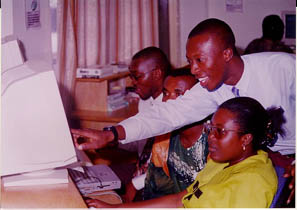
Empowerment: Networking for Local Development is the theme chosen by the NGOs to describe their new Community Information Center (CIC) initiative. With USAID support provided by LearnLink, the CICs are offering an array of communications and education technologies, including access to the Internet, to residents in three Ghanaian communities. The NGOs manage and run the Centers while LearnLink’s Resident Advisor and staff in Washington, D.C. lend their expertise to ensure that the Centers operate with appropriate, state-of-the-art applications, have a good shot at sustainability, and achieve measurable impact on community needs and priorities. One of the greatest strengths of the CIC program is its focus on training. To prepare the Center staff to run the Centers and the host NGOs to manage them, LearnLink’s Resident Advisor, Jonnie Akakpo, has offered training courses on computer literacy, Internet orientation, word processing, spreadsheets, presentation graphics and other software applications, as well as web site development, accounting, the development of business plans, training methodologies, and presentation skills. To engage the community, the host NGOs have offered similar training opportunities to the public. The response has been enthusiastic, demonstrating the potential of the CIC activity. During one three-month period, for example, 70 clients registered for programs at the CEDEP NGO, including 45 males and 25 females, among whom 53 were students and teachers and the rest administrators and technicians. Programs of interest included computer literacy, Internet orientation and self-tutoring typing. Jonnie Akakpo and the NGOs also have organized public seminars on topics of interest, including "Y2K: Origin, Myths, Realities and Solutions" and "The Internet and its Benefits to Society." Both have been well attended, indicating the growing market for computer and Internet awareness among the Ghanaian population. More focused seminars are being designed, as well, to meet the specific needs of community constituents. An example that targets the business community is "The Computer as a Tool in Medicine," which was organized for a medical practitioners association in Kumasi. Policies for Financial Sustainability This approach sets a solid foundation for the ultimate sustainability of the centers, which will count largely on client fees to operate when external funding ends. As community needs are identified and CIC services are geared to meet them, the NGOs are designing realistic pricing and usage policies. At CEDEP, for example, a four-tiered pricing policy has been adopted, with students and teachers at the lowest end followed by NGOs and community-based organizations, public and civic servants, and the business community. To date, the most promising CIC income-generating activity is the provision of email accounts and Internet access. Two of the three NGOs in Ghana earned their first income by providing email and Internet access to local businesses. Things start small -- as Jonnie Akakpo initially reported, "The CEDEP CLC made its first income of two thousand cedis [USD $0.78] . . . from two e-mails sent by the Pan-Africa Arts Festival Secretariat" -- but they grow. In a recent month, one of the centers earned the equivalent of over USD $5,000 from user fees, greatly strengthening the conviction that the centers will ultimately be able to sustain themselves. To facilitate long-term sustainability, fee and management structures are being put into place, and community involvement, as well as increased collaboration with the private sector, is actively promoted.Ultimately, it is hoped that the CICs will evolve to meet the multimedia needs of a variety of organizations, companies and individuals throughout the country. To ensure relevance to constituent priorities, needs assessments are being conducted to identify products and services in demand, and CIC staff are trained to help visitors become familiar with the technologies, resources and services offered at the Centers. The three NGOs are working to create a CIC environment that is conducive to learning and arrange staff training in management, computer operations and outreach. They also have established monitoring mechanisms to measure initial demand and will work with LearnLink staff to collect baseline data and create an evaluation tool to assess the impact of the CICs on community learning systems. Practical Lessons of Technical and Social Environments Access to computers, the Internet and email is a new phenomenon in Ghana. As such, LearnLink’s Resident Advisor wisely set prerequisite technical criteria before allowing the installation of the computer equipment in the NGO facilities. He was concerned with space suitability and the security of the area, as well as the provision of furniture, the installation of telephone lines, and air conditioning. One NGO balked at the need to carpet the room containing the computers, for example, though it acquiesced when Mr. Akakpo explained that carpeting was needed to absorb dust that otherwise would be freely circulating in the room. Of particular concern was the adequate supply of electrical power, which he ascertained through voltage readings. To date, two of the three NGOs have passed Mr. Akakpo’s inspection. Another lesson already learned is the importance of engaging a local champion with extraordinary commitment, enthusiasm, endurance and patience, as well as competent technical expertise and an understanding of local conditions and ways of life. In Ghana, the project has benefited greatly from Jonnie Akakpo’s savvy technical, cultural and managerial insights. The inaugurations of Ghana’s CICs have been joyous occasions, welcomed with excitement and anticipation at the local and national levels. At the CEDEP opening, for example, held in Cape Coast, over 150 people attended the celebration, including dignitaries, academics, students, business people, CEDEP’s NGO partners, the press and people from all walks of life.Good relations with community and government are another crucial lesson. Not only does involving them help to secure their support, but it garners lots of good publicity as well. In one inauguration, the Minister of Communication pledged his support for the CICs. Stressing Ghana’s entry into the computer age, the Ministry of Education representative urged students to make good use of the facilities to enhance their performance and to learn about computers and the Internet. The Queen mother of Mampong Kronko, Nana Aboagyewaa Kente, cut the tape to the CIC facility. The launch was widely covered by local and national media, with interviews on FM radio stations, television news spots and print media articles announcing the opening and potential of the CIC.Looking Ahead These successful activities are building on the contributions of many players. In these early phases, external support has been vital. As the demand for such activities and the financial self-sustainability is demonstrated, we are optimistic that other NGOs and local entrepreneurs will step forward to help the concept grow, providing an access route for all Ghanaians to participate in the benefits of the technology.LearnLink, USAID Contract HNE-I-00-96-00018-00, is funded by the Human Capacity Development Center in the Global Bureau, the Africa Bureau, and other Bureaus, offices and missions, and is operated by AED. 
|
|
|
For feedback on this article, please write to: TechKnowLogia@KnowledgeEnterprise.org |
|
|
Subscribe | Reader Feedback | To Sponsor | To Advertise Editorial Network | Editorial Policy | Home |
|
|
|
|
| TechKnowLogia, September/October 1999 | Copyright © 1999 Knowledge Enterprise, Inc. |