
|
Electronic Books
The future of publishing?
James Johnson Fundamental to the education and learning enterprise worldwide is the use of textbooks, reference books and other published materials by teachers and students alike. This familiar teaching tool is undergoing a substantial change, much like the invention of movable type and the printing press more than 500 years ago. The idea of electronic books has existed in science fiction since the1940s. Like the early versions of computers as TV sets on top of typewriters, early designs of electronic books were bulky and non-portable Electronic "Readers" When the Web and the Internet were in their infancy, desktop computers and PC/laptops became the first electronic "readers." Students and other users could download text materials from the Net, usually for storage and later printing for reading. Enterprises like Project Gutenberg and the Peanut Press (www.peanutpress.com) began digitizing as many public domain texts as they could get hold of for downloading from the Net. Desktop and laptop screens are suitable for reading e-mail and searching the Internet, but the screen glare, bad layout, the intervention of the keyboard and the readers’ posture annoyances make on screen "reading" unsuitable for most serious readers, learners and researchers. Electronic "Books" The new generation of electronic books addresses these issues by offering a range of specially designed reader-friendly hardware, into which selected texts are downloaded electronically from the Net, or inserted on coded cards. E-books offer instant access to the full text of the book you want now. Purchase a text from a web site and download it. Bits via the Internet are delivered immediately instead of atoms via mail. 
NuvoMedia of Palo Alto, Calif., with its Rocket eBook (www.rocket-ebook.com) priced in stores at $350, offers sufficient memory to hold 4000 pages of text, about 10 novels worth of reading. It is handheld and weighs 22 ounces. The batteries for the sing le screen display in black and white last for 33 hours. Texts can be downloaded from Internet sites first onto the customers PC, and through a cradle plugged into the serial port, into the eBook’s memory. With a stylus, commands to browse, search, annotate and underline can be entered onto the eBook. 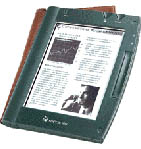
SoftBook (www.softbook.com) offers a single screen backlighted monochrome LCD that enables reading in the dark. The battery lasts for 5 hours, and offers memory to store 1,500 pages, potentially upgradable to a maximum 100,000 pages of text. The delivery system consists of an installed 33.6Kbps modem that dials into the SoftBook Network, a virtual bookstore, which delivers about 100 pages per minute. With a $299 take home price, you are obligated to a $9.95 a month, two-year plan for downloading books. This fee is waived, if you agree to spend at least $19.95 a month in virtual books for two years. Librius.com (www.librius.com), based in Bellevue, Wash., offers for $199 a 12-ounce Millenium e-book that will hold 10 full-length books, about 8,000 pages. The paperback book sized screen is equally readable in bright light and semidarkness, and will display tests in a variety of fonts and languages. The battery life is between 17 and 33 hours. Downloading of texts is through a serial connection on a Windows or Mac computer. Next Generation E-Books 
The next generation of e-books, coming to market in 2000 is led by the EB Dedicated Reader, produced by Everybook of Middletown, PA. (www.everybook.net). The EB Dedicated Reader is unique with its two page, side-by-side color LCD touch screens. The total reading area is 11" by 17", with a storage capacity of 500,000 pages, or about 200 college-size textbooks, on each 5-mb memory cards inserted into the side of the reader. A custom-designed ROM treats the two facing screens as though they were a single display page. The EB Dedicated Reader will cost about $1500 for the professional model, and about $500 for a personal model planned for later in the year. The EB Dedicated Reader is developed to accept the Adobe PDF format, in which more than 90 percent of all materials on the Internet are stored. This allows for the text to appear in full color with the clarity approaching the printed pages of illustrated texts. Advantages of E-Books Unlimited numbers of digital texts online will soon be available at much lower costs than hard books. Publishers cannot risk offering books in paper print that will not sell to a wide audience. This limits what gets published and distributed. With e-publishing, the economics of making available a wider variety of works change substantially. No book need go out of print. Any book can remain available. Authors can self-publish and upload their works onto a distribution web site. Scholars can retrieve and rediscover masterpieces overlooked in museums and libraries. Teachers who now compile class readers by photocopying chapters from original textbooks (with or without the publisher’s permission) can customize e-editions for their students, and publishers can charge lesser appropriate fees. University and college students can receive the text materials for their entire course of studies on an ebook, and update it through the year. With minimal overhead costs for printing, storing and shipping, the price of books should fall dramatically. Classic literature in the public domain could become readable at no charge. Even in libraries, availability of learning materials will no longer be limited to the number of books on the shelf. For professionals in education, research, medicine and law who must spend thousands of dollars a year in reading current information and knowledge materials, the e-book will allow access to references and updates at a fraction of current costs. E-books will enable immediate distribution and access to the latest information for institutions and businesses requiring employees to access manuals and instruction books. Information will be available on demand with a resulting benefit to the environment. Versions of e-books coming to the market will allow readers to make marginal notes, underline sections, search for specific words or ideas, or find the definition of unfamiliar words. Educational and learning institutions will be the first to benefit from these new developments in electronic books. Additional developments to watch for include books that read themselves aloud, and also offer sounds and music to accompany the texts .
|
|
|
For feedback on this article, please write to: TechKnowLogia@KnowledgeEnterprise.org |
|
|
Subscribe | Reader Feedback | To Sponsor | To Advertise Editorial Network | Editorial Policy | Home |
|
|
|
|
| TechKnowLogia, September/October 1999 | Copyright © 1999 Knowledge Enterprise, Inc. |